

December 2024
Overview
- FedDev Ontario organizational overview
- Southern Ontario community overview
- FedDev Ontario’s role in communities
- FedDev Ontario’s programs and services
- FedDev Ontario’s impact
Fueling economic development in southern Ontario
FedDev Ontario at a glance
Mandate
To strengthen southern Ontario’s capacity for innovation, economic development and growth
Vision
A green, inclusive and globally competitive southern Ontario economy that fosters innovative and growing businesses, economically diversified and resilient communities, and meaningful employment
- One of seven Regional Development Agencies (RDAs) across Canada
- A strong federal presence that understands the region’s challenges and opportunities
- Capacity to respond rapidly when unexpected economic conditions occur
- Four offices: Waterloo (HQ), Toronto, Peterborough and Ottawa
FedDev Ontario’s evolution

2009
- FedDev Ontario was created following the economic downturn, with a temporary five-year mandate
- The Agency’s investment focus was on providing stimulus during an economic crisis
2019
- FedDev Ontario was made a permanent Agency and named a flagship platform for delivering the Innovation and Skills Plan (together with other RDAs)
- Agency investments focused on innovation and scaling high-potential companies, as well as smaller communities and rural areas
2021
- FedDev Ontario supported the government’s response to the pandemic with rapid delivery of new funding programs
- First dedicated Minister for FedDev Ontario
2024 and beyond
- FedDev Ontario is increasing engagement efforts and refocusing on our core mandate to build a stronger, more sustainable and inclusive economy
Organizational structure
Nancy Gardiner, President
As the Deputy Head of the Agency, the President is responsible for its overall strategic direction to deliver on the Minister’s mandate, and is supported by the following leadership team :
Office of the President
Irwin Cortez
A/ Chief of Staff
Corporate Secretary
Manages coordination between the Minister’s office and the Agency, and corporate secretariat functions
Programs
Linda Cousineau
Vice President
Business, Innovation and Community Development
Responsible for managing the Agency’s program delivery
Policy and Partnerships
Steve Masson
A/Vice President
Policy, Partnerships and Communications
Responsible for policy and program development, evaluation, stakeholder engagement, and communications
Corporate Services
Carole Bourget
Chief Financial Officer
Manages the Agency’s Budget and is responsible for corporate functions such as technology assets, security, and information management
Human Resources
Raquel Fragoso
Director General
Human Resources
Responsible for the delivery of HR policies, programs and services, including talent attraction, classification and organizational design, equity and diversity, and labour relations
Communications
Kerri Dunning
Director General
Communications and Public Affairs
Manages and plans Ministerial events and announcements
*Reports to the VP of Policy, Partnerships and Communications
Home to diverse subregions comprised of 289 communities
Toronto and surrounding communities – a key driver of Canada’s growth and knowledge economy strengths
Kitchener-Waterloo and Ottawa – cities with sectoral strengths in tech and innovation
Southwestern Ontario – well-linked opportunities to foster future growth (e.g., clean technology in Sarnia, automotive sector in Windsor and health sciences in London)
Eastern Ontario – unique local assets and opportunities (e.g., Belleville’s packaging manufacturing and food processing, Peterborough’s clean tech and water purification strengths)
Small and rural communities – facing diverse opportunities and challenges (e.g., Kincardine and Carleton Place)
Indigenous communities – First Nations, Inuit and Métis people make up a population of approximately 253,000 in southern Ontario. There are 33 reserves in southern Ontario, including Canada’s two largest First Nations reserves; Six Nations of the Grand River and Mohawks of Akwesasne
FedDev Ontario - catchment area and census divisions
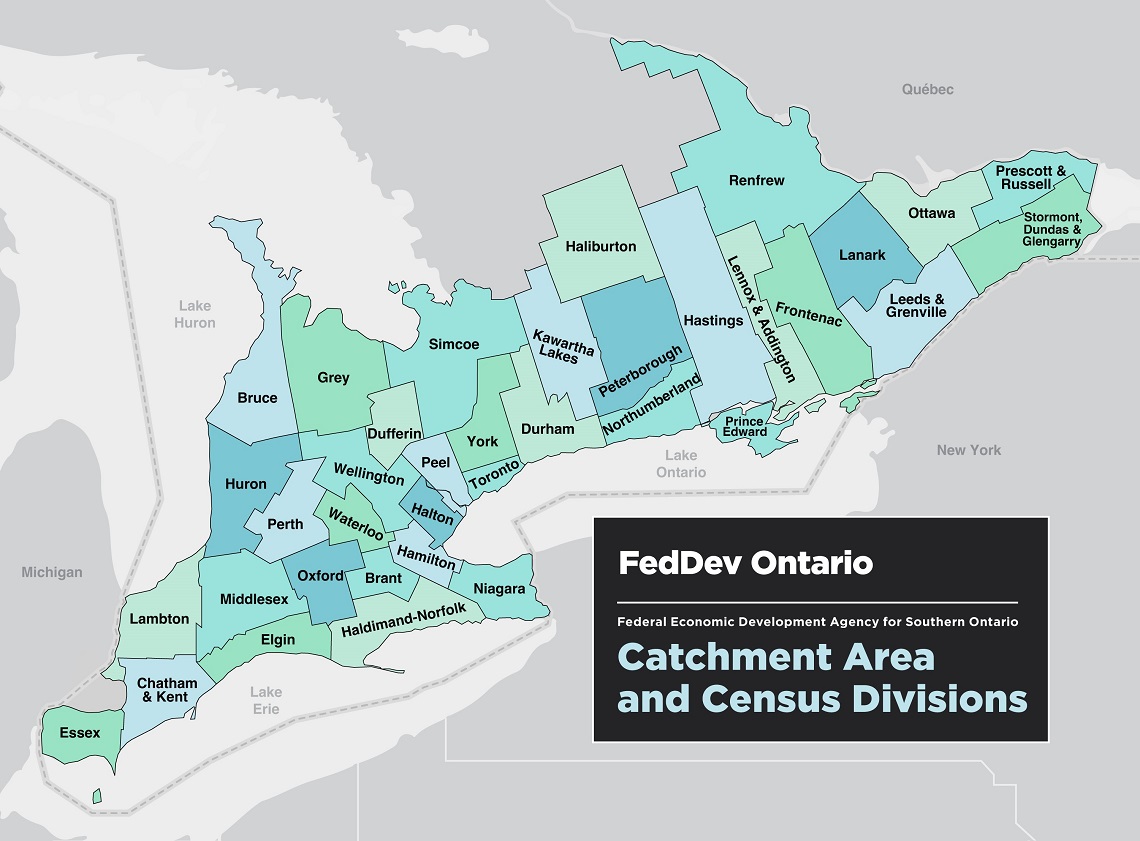

Home to the Greater Toronto and Hamilton Area, which accounts for 19% of Canada’s population (2023)

Around 3.6 million live in small and rural communities (~25% of the population)
The region is a key driver of Canada’s growth
- 38% of Canada’s GDP at ~$1.1 trillion
- 35% of Canada’s Goods Exports ($252.3 billion in 2023, $208.4 billion from Jan-Oct 2024)
- Strengths in automotive, aerospace, life sciences, financial services, information and communications technology (ICT), Artificial Intelligence (AI), and agri-food
- Home to 35 post-secondary institutions, some 70,000 annual science, technology, engineering and mathematics (STEM) graduates and over 650,000 jobs in STEM fields
- With more than 130 business accelerators, incubators and innovation hubs; Ontario attracts 48% of venture capital (VC) investment in Canada (2023).
- The region is home to more than 480,000 firms; and 33 of the country’s 50 fastest growing companies (2020-23) are Ontario-based.
- Significant and growing strengths in areas such as Electric Vehicles, Artificial Intelligence (AI) and Quantum computing
The region’s economy
Manufacturing is an important contributor to Ontario’s GDP
- Manufacturing accounts for 11% of the province’s economy and represents 45% of Canada’s manufacturing sector (2023)
- However, growth in this sector has been stagnant for about 20 years and its share of the economy has declined 41% since 2005
- Important transformations are underway, including the shift to EV production, greener energy production, and the emergence of AI
Knowledge-intensive services, including information and communications technology (ICT), finance, professional services (e.g. management consulting, legal, accounting, engineering services) and life sciences are increasingly fueling growth
- Employment in life sciences and tech grew faster than employment in the overall economy in 8 out of the last ten years
- 36% increase in ICT jobs between 2013 and 2023; almost 41,000 new jobs added since 2020
Regional economic considerations
Housing affordability
21.7% of Ontario’s households are estimated to have sufficient income to buy a single-family home under current conditions. With interest rates continuing to fall, banks are now more optimistic about individuals with mortgages coming up for renewal.
Wealth gap forming
Households’ net worth as a share of disposable income in Ontario reached 350% (2024 Q2) for those under 35 while it was 1,517% for those aged 55 to 64.
Interprovincial outmigration
An increasing number of Ontarians have left the province (112,000 in 2022-23); double the number from 2000-01. Approximately 70% of those who left are 39 years old or younger.
Moderate near-term growth
Ontario is on track to end 2024 with low growth, due to slow consumer spending, lagging business investment, increased competition for talent and investment dollars, and low productivity gains. A better performance is forecast for 2025.
Canada-US relations
Canada and the U.S. share a deeply interconnected relationship, with the U.S. being the top destination for Ontario’s goods exports. Tariffs on Canadian goods could harm the region’s near-term outlook, particularly affecting border communities whose local economies are highly integrated with U.S. supply chains.
FedDev Ontario plays key roles for the federal government in the region
- Co-investor
- Convenor
- Champion
- Pathfinder
FedDev Ontario’s investment focus
Key areas of focus:
- Clean economic growth: projects that support the greening of the economy, that can contribute to emissions reductions, and that create sustainable and green jobs
- Growth companies: projects that accelerate business development and growth
- Technology: projects in cutting-edge sectors
- Industrial transition: projects that support change in traditional sectors to adopt new technologies and other innovations to improve their competitiveness and build new opportunities
- Inclusive growth and regional coverage
Zero-emissions vehicles, artificial intelligence, and housing manufacturing innovation are also sectors of priority for the region
FedDev Ontario’s investments can help businesses:
- Grow, scale operations and export globally
- Adopt technology, automate, digitize processes (e.g., cybersecurity, artificial intelligence)
- Create jobs, accelerate commercialization, diversify and expand
- Develop clean technologies and green operations
- Break barriers to achieve equity and diversity
In addition, the Agency is helping to maximize the region’s economic potential by ensuring that businesses have the support they need to remain competitive and innovative through periods of economic uncertainty.
The Agency also supports not-for-profits in southern Ontario’s innovation ecosystem through investments in accelerators and incubators, clusters and community organizations.
Convening partners and championing the region to drive growth
FedDev Ontario collaborates closely across the federal family, with the province and with many non-governmental organizations

With Innovation, Science and Economic Development Canada (ISED) and other federal departments on project cross-referrals, and on key government economic priorities

With other RDAs on the development and delivery of national programs and on policy research in areas of shared interest (e.g., rural innovation)

With the Government of Ontario through information sharing, co-investment and referrals, and working together in areas of common priority
Delivering programming that falls into three categories
Ongoing regional programs
National programs
Program status legend:
- Funding limited to Community Futures Development Corporations and Networks
- Intake open
- Intake closed
Flexible and responsive ongoing regional programs
Regionally tailored programs that promote short- and long-term job creation and economic development in southern Ontario
Three ongoing funding streams in the form of repayable contributions to businesses and non-repayable to not-for-profits:
Business Scale-Up and Productivity (BSUP)
Help companies adopt and develop new, innovative technologies that support growth and productivity
Regional Innovation Ecosystems (RIE)
Support for not-for-profit organizations to develop strong and inclusive regional innovation ecosystems
The BSUP and RIE streams together constitute the Regional Economic Growth through Innovation (REGI) program, common to all RDAs
Community Economic Development and Diversification (CEDD)
Support for not-for profit organizations and businesses that help small and rural communities grow their economies
The CEDD stream was developed by the Agency, specifically for southern Ontario
National programs delivered by all RDAs
Supporting diverse and inclusive economic growth and responding to time-sensitive opportunities and challenges
Ongoing national programs
Community Futures Program
Supports the operations of southern Ontario’s 36 Community Futures Development Corporations (CFDCs), who provide business advice and administer loan pools, to support the growth of rural businesses
Economic Development Initiative
Supporting Francophone and bilingual organizations that provide business and economic development programs or services in French
Time-limited national programs
Regional Quantum Initiative
Offering targeted support to SMEs with quantum technologies and solutions (intake closed; program ends March 31, 2028)
Black Entrepreneurship Program Ecosystem Fund
(intake closed, program ends March 31, 2025)
Tourism Growth Program
(intake closed, program ends March 31, 2027)
Regional Artificial Intelligence Initiative
(Intake open, closes December 20; program ends March 31, 2029)
Regional Artificial Intelligence Initiative
(Intake open, closes December 20; program ends March 31, 2026)
| Actual expenditures | Planned expenditures | |||
|---|---|---|---|---|
| 2021-2022 | 2022-2023 | 2023-2024 | 2024-2025Footnote1 | |
| Operating | $39M | $41M | $41M | $37M |
| Grants and contributions | $357M | $553M | $416M | $216M |
| Total | $396M | $594M | $457M | $253M |
- Footnote 1: Includes REGI Top-up Sunsetter Renewal/Regional Homebuilding Innovation Initiative and Securing the Regional Artificial Intelligence Initiative.
Delivering strong results for southern Ontario
Since 2015, this Agency has invested over $2.8 billion, in over 3,620 projects that align with economic priorities and regional opportunities
For every $100 million of FedDev Ontario’s investments through regional ongoing program streams:
9,000+
Jobs are created and maintained
$235M
Is leveraged in additional investment
Recipient firms tend to outperform comparable to businesses:
+12% Revenue growth
+24% Employment growth
+18% R&D spending
+40% Export growth