
Fueling economic development in southern Ontario

- One of seven Regional Development Agencies (RDAs) across Canada.
- A strong federal presence that understands the region’s challenges and opportunities.
- Capacity to respond rapidly when unexpected economic conditions occur.
- Four offices: Waterloo (HQ), Toronto, Peterborough and Ottawa.
FedDev Ontario’s evolution

2009
- FedDev Ontario was created following the economic downturn, with a temporary five-year mandate.
- The Agency’s investment focus was on providing stimulus during an economic crisis.
2019
- FedDev Ontario was made a permanent Agency and named a flagship platform for delivering the Innovation and Skills Plan, alongside its RDA counterparts.
- Agency investments focused on innovation and scaling high-potential firms, as well as supporting economic development in rural and small communities.
2021
- FedDev Ontario supported the government’s response to the pandemic with rapid delivery of new funding programs.
- First dedicated Minister for FedDev Ontario.
2026 and beyond
- FedDev Ontario is focusing on its core mandate to build a stronger, more competitive, and diversified economy.
Organizational structure
The Honourable Evan Solomon
Minister of Artificial Intelligence and Digital Innovation and Minister responsible for the Federal Economic Development Agency for Southern Ontario.
Kaili Levesque, President
As the Deputy Head of the Agency, the President sets the overall strategic direction to deliver on the Minister’s mandate and is supported by the following leadership team:
Programs
Linda Cousineau
Vice President
Business, Innovation and Community Development
Responsible for managing the Agency’s program delivery.
Policy, Partnerships and Communications
Steve Masson
Vice President
Policy, Partnerships and Communications
Responsible for policy development, evaluation, stakeholder partnerships, and communications.
Corporate Services
Carole Bourget
Chief Financial Officer
Manages the Agency’s Budget and is responsible for corporate functions such as technology assets, security, and information management.
Human Resources
Paulette Prentice
Director General
Human Resources
Responsible for the delivery of HR policies, programs and services, including talent attraction, classification and organizational design, equity and diversity, and labour relations.
Southern Ontario
A region shaped by 289 diverse and dynamic communities.
Toronto and surrounding communities — Leading region for innovation, technology development, and knowledge intensive sectors.
Kitchener-Waterloo and Ottawa regions — Leading tech and research hubs specializing in digital tech, cybersecurity, defence, and advanced computing.
Southwestern Ontario — Diverse growth opportunities, including clean tech (Sarnia), automotive and battery supply chain innovation (Windsor / St. Thomas), and health sciences (London).
Eastern Ontario — Unique local assets and opportunities in manufacturing, food processing (Belleville), clean technology, and water-technology innovation (Peterborough).
Small and rural communities — Key contributors to agriculture, tourism, and resource–based industries, yet often face economic and demographic pressures, including dependence on a single or few industries.
Indigenous communities — First Nations, Inuit, and Métis people make up a population of approximately 253,000 in southern Ontario. There are 33 reserves in southern Ontario, including Canada’s two largest First Nations reserves (Six Nations of the Grand River and Mohawks of Akwesasne).
FedDev Ontario – catchment area and census divisions
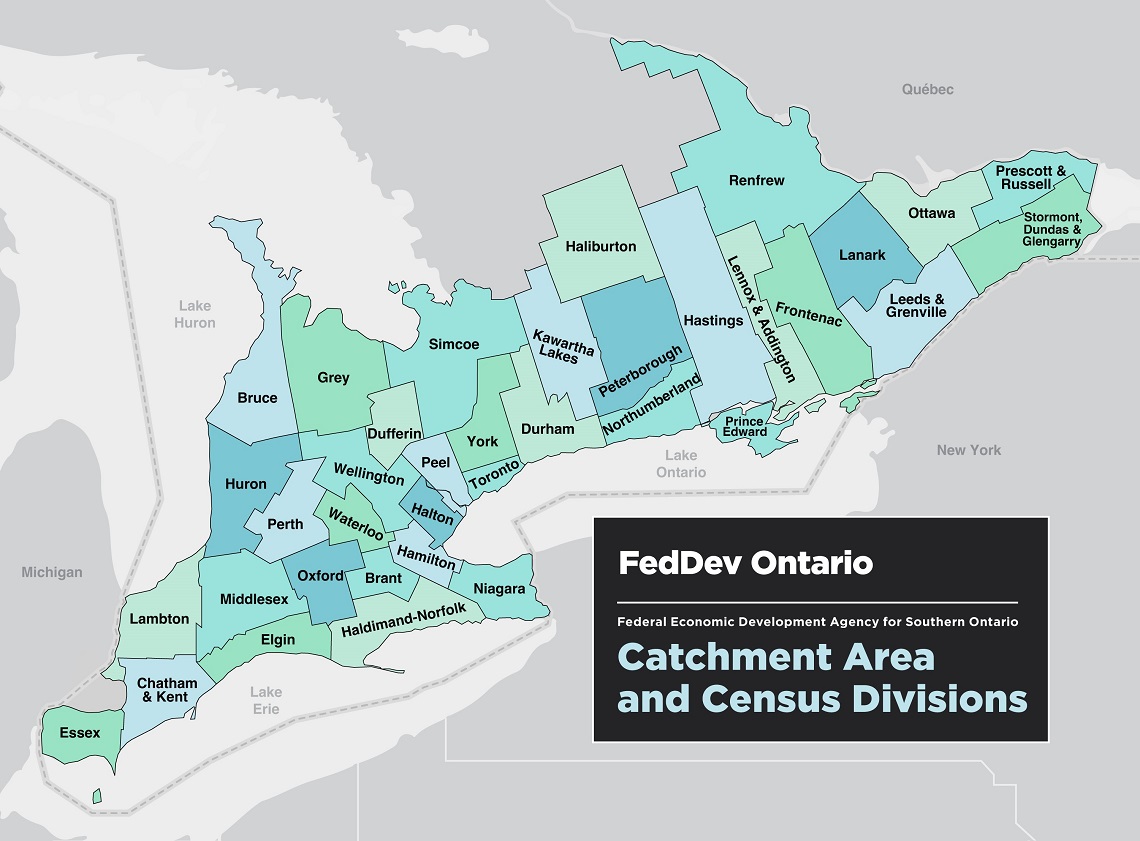

Southern Ontario is home to the Greater Toronto and Hamilton Area, which accounts for approximately 20% of Canada’s population (2024).

Around 3.6 million live in small and rural communities (~25% of the population).
A key contributor to the Canadian economy
- 39% of Canada’s Real GDP (approx. $960B in 2024)
- centre of Canada’s Venture Capital (VC) landscape with over 48% of VC dollars going to Ontario-based firms in 2025
- 37% of Canada’s goods exports in 2025 ($266.6B)
- home to tech leaders such as Cohere and Shopify
- 35 Post-secondary Institutions in southern Ontario and some 70,000 annual science, technology, engineering and mathematics (STEM) graduates
- nearly 44% of Canada’s manufacturing output and 47% of its exports
- attracts the most newcomers to Canada (44% to Ontario, and approx. 27% to the GTA alone in 2025)
- 442K+ firms (BR2025), and home to 27 of the 50 top growing companies in the country (2025)
Population and labour market overview
- southern Ontario population (2025): 15.4M
- share of Canada’s population: 36.9%
- southern Ontario employment (Jan. 2026): 7.8M
- share of Canada’s employment: 37.5%
- southern Ontario unemployment rate (Jan. 2026): 6.5%
- Canada unemployment rate: 6.7%
Ontario’s top 5 sectors by GDP share
- real estate (13.4%)
- finance and insurance (9.9%)
- manufacturing (9.5%)
- professional, scientific and technical services (8.5%)
- public administration (7.5%)
The regional economy
Southern Ontario's regional economy is driven by:
A core manufacturing base supported by highly integrated supply chains
Strengths in automotive, aerospace, advanced materials, and clean technology that together represent a major share of Ontario’s economic output.
A globally renowned innovation and tech ecosystem
Well-positioned to capitalize on rapid growth in artificial intelligence and other transformative digital technologies.
Significant agri-food production and processing capabilities
A major contributor to provincial exports, supported by farming, processing, and distribution networks.
Growing defence and energy industries
Generating high-value jobs, strengthening supply chains, diversifying trade, and enhancing competitiveness in global markets.
A leading life sciences sector
Anchored by biotechnology, medical research, Medtech, and pharmaceuticals, supported by major universities and hospitals.
A large services sector
Driven by education, healthcare, and public administration; providing employment stability and broad regional economic activity.
Canada's largest concentration of financial and real estate industries
A hub for banking, insurance, and fintech activity; alongside an expansive real estate sector driving construction, infrastructure, and capital flows.
Impact of U.S. tariffs
Southern Ontario is the most heavily impacted region in Canada.
- Approximately 1 in 9 Ontario jobs (933,000 workers) depend on U.S. export demand.
- The U.S. is Ontario’s largest trading partner, accounting for ~72% of the province’s goods exports in 2025 (~77% in 2024).
- Ontario’s manufacturing sector is particularly reliant on US trade, with 46% of its sales exported to the U.S.
- Several of Canada’s most tariff exposed communities are located in southern Ontario.
While U.S. tariffs have affected many sectors critical to southern Ontario’s economy, the two hardest hit industries are:
Automotive manufacturing
(25% tariff on non-U.S. content in vehicles)
Ontario’s auto manufacturing sector (more than 95,000 workers) is the province’s largest export industry and is deeply integrated with U.S. supply chains.
- Autos and parts exports to the U.S. totalled $60B in 2025, representing 96% of Ontario’s auto exports.
- The region has seen permanent plant closures and reduced production levels.
- Smaller suppliers are most exposed: over 95% have fewer than 500 employees but account for 61% of the automotive workforce.
Steel and aluminum
(50% tariff on aluminum and steel imports)
Southern Ontario hosts two of Canada’s three largest steel producers.
This industry is concentrated in high value products and supplies several industries, such as automotive and machinery.
Ontario’s steel and aluminum exports to the U.S. reached $6.5 billion in 2025 – 94% of the provincial total.
2026 economic outlook
Short-term softness, long-term resilience
Growth
Real GDP growth is expected to strengthen, rising from 1.2% to 2.3% by 2027 (y/y).Footnote 1 Services sector is likely to support positive real GDP growth in 2026.
Labour market
Economic uncertainty continues to weigh on Ontario's labour market, with only a slight easing in unemployment expected (from 7.6% in 2026 to 7.4% in 2027).Footnote 1
Population
Immediate changes to the immigration programs are expected to slow population growth more sharply in Ontario and BC than in other provinces through 2028, due to their larger share of non-permanent residents.Footnote 2
Inflation
CPI continues to moderate, moving closer to target.
| Year | 2010–19 | 2023 | 2024 | 2025E | 2026F | 2027F |
|---|---|---|---|---|---|---|
| Real GDP (annual % change) | 2.3% | 2.4% | 1.6% | 1.3% | 1.2% | 1.7% |
FedDev Ontario's key roles in the region
- Invest: Driving targeted investments in businesses, communities and organizations to fuel growth and build a strong regional economy.
- Connect: Deploying local expertise to ignite powerful partnerships and spark cross-sector opportunities in southern Ontario.
- Inform: Delivering timely, actionable intelligence to guide decisions, drive impact, and position the region to lead.
Investing in southern Ontario
Raison d’être
FedDev Ontario works with communities, businesses, not-for-profit organizations, and other orders of government in southern Ontario to strengthen the region's capacity for innovation, economic development, and growth.
The Agency transforms regional opportunities into national economic advantages through programs delivered under two key pillars:
Investing to BUILD and COMPETE
- scaling high potential firms and growing strategic sectors
- commercializing innovation and strengthening regional ecosystems
Investing to STRENGTHEN and SUPPORT
- strengthening resiliency and anchoring firms in their communities
- building an economy that works for everyone
FedDev Ontario funding programs
Through its flexible, regionally-tailored programs, FedDev Ontario makes targeted investments in SMEs, communities, business support organizations, and regional ecosystems, supporting both for-profit businesses and not-for-profit organizations:
Investing to BUILD and COMPETE
Ongoing regional programming
- Regional Economic Growth Through Innovation (REGI)
- Business Scale-Up And Productivity – Continuous intake
- Regional Innovation Ecosystems - Continuous intake
Targeted, temporary programs
- Regional Defence Investment Initiative – Intake open
- Regional Artificial Intelligence Initiative – Intake closed
- Regional Quantum Initiative – Intake closed
- Regional Homebuilding Innovation Initiative – Intake closed
Investing to STRENGTHEN and SUPPORT
Ongoing regional programming
- Southern Ontario Prosperity Program (SOPP)
- Community Economic Development and Diversification
Targeted, temporary programs
- Regional Tariff Response Initiative – Intake open
- Black Entrepreneurship Program – Intake closed
- Tourism Growth Program – Intake closed
Ongoing national programming
- Community Futures Program - Cycle-based renewal
- Economic Development Initiative - Continuous intake
Pillar 1 programming
Investing to BUILD and COMPETE
The Agency is investing in high-potential opportunities to drive innovation, productivity, and growth in southern Ontario.
Ongoing regional programs
Business Scale-Up and Productivity
Supports high-growth businesses that are scaling up and producing innovative goods, services or technologies.
Regional Innovation Ecosystems
Invests in projects from not-for-profit entities to create, grow, and nurture inclusive regional ecosystems that support business needs and foster an entrepreneurial environment.
Targeted, temporary programs
Regional Defence Investment Initiative
Supports businesses’ integration into domestic and global defence supply chains, strengthening innovation and industrial capacity to advance Canada’s defence needs and regional economic growth.
Program ends March 31, 2028
Note: For FedDev Ontario, the Regional Defence Investment Initiative includes an additional year of program authorities beyond the currently stated end date
Regional Artificial Intelligence Initiative
Helps bring new AI technologies to market and helps accelerate AI adoption in critical sectors.
Program ends March 31, 2029
Regional Quantum Initiative
Helps companies advance and commercialize their quantum products and solutions for domestic and global markets.
Program ends March 31, 2028
Regional Homebuilding Innovation Initiative
Supports new approaches to homebuilding including modular design and upscaling, the use of 3D printing, and panelized construction.
Program ends March 31, 2026
Pillar 2 programming
Investing to STRENGTHEN and SUPPORT
The Agency is driving resiliency and prosperity in the southern Ontario economy by anchoring firms in the region, supporting businesses and communities vulnerable to economic challenges (e.g., tariffs, supply chain breakdowns, global market shifts) and building a more resilient, inclusive regional economy.
Ongoing regional program
Community Economic Development and Diversification
Supports not-for-profit organizations and businesses that help small and rural communities diversify and grow their economies.
National programs
Community Futures Program
Supports the operations of southern Ontario’s 36 Community Futures Development Corporations (CFDCs), who provide business advice and administer community-based loans to support the growth of rural businesses.
Economic Development Initiative
Supports Francophone and bilingual not-for-profit organizations that provide business and economic development programs or services in French.
Targeted, temporary programs
Regional Tariff Response Initiative
Aims to help businesses affected by tariffs and trade disruptions improve productivity, diversify markets, and strengthen supply chains.
Program ends March 31, 2028
Black Entrepreneurship Program Ecosystem Fund
Aims to strengthen the entrepreneurship ecosystem for Black entrepreneurs and business owners across Canada.
Program ends March 31, 2030
Tourism Growth Program
Aims to support communities, SMEs, and not-for-profit organizations in developing local tourism products and experiences.
Program ends March 31, 2026
Building regional partnerships to accelerate growth
FedDev Ontario gathers on‑the‑ground intelligence and stays current on emerging trends, challenges, and opportunities in southern Ontario, enabling informed decision‑making that supports regional growth and development.
In doing so, FedDev Ontario collaborates closely across the federal family, with the province and with many non-governmental organizations, including:

With Innovation, Science and Economic Development Canada (ISED) and other federal departments on project cross-referrals, and on key government economic priorities.

With other RDAs on the development and delivery of national programs and on policy research in areas of shared interest (e.g., rural innovation).

With the province of Ontario through information sharing, co-investment and referrals, and working together in areas of common priority.
FedDev Ontario also provides other ongoing services to firms and other stakeholders:
Small business services:
Informs businesses about federal and provincial programs and services to help them start, grow, and adapt.
Defence concierge service:
Helps southern Ontario organizations connect with opportunities across Canada's defence supply chain.
Supporting the government’s priorities in the region
FedDev Ontario is well-positioned to deliver on the Government of Canada’s mandate and is committed to advancing its central economic priorities:
Establishing a new economic and security relationship with the United States and strengthening our collaboration with reliable trading partners and allies around the world.
Objective: Support sustainable economic development and diversification in southern Ontario.
Building one Canadian economy by removing barriers to interprovincial trade and identifying and expediting nation-building projects that will connect and transform our country.
Objective: Advance the competitiveness of the southern Ontario economy.
Protecting Canadian sovereignty and keeping Canadians safe by strengthening the Canadian Armed Forces, securing our borders, and reinforcing law enforcement.
Objective: Support the development and deployment of dual-use applications, products, and technologies to de-risk their uptake into both domestic and international defence supply chains.
Making housing more affordable by unleashing the power of public-private cooperation, catalyzing a modern housing industry, and creating new careers in the skilled trades.
Objective: Advance innovative homebuilding methods and boost productivity in southern Ontario’s homebuilding sector.
Advancing the Government of Canada's Industrial Strategy
FedDev Ontario plays a key role in supporting the Industrial Strategy and advancing national economic priorities through its core programs.
Industrial Strategy
Centered around three pillars - PROTECT, CREATE, and ATTRACT - the Strategy includes several flagship initiatives:
- Defence Industrial Strategy
- Major Projects Office
- Climate Competitiveness Strategy
- Build Canada Homes
- Trade Diversification Strategy
- Buy Canadian Policy
Complementary economic initiatives
- Artificial Intelligence Strategy
- International Talent Attraction Strategy
- Strategic Response Fund
- Critical Minerals Production Alliance
- Auto Strategy
- Life Sciences Strategy
- Food Security Strategy
- Nature Strategy
Delivering strong results for southern Ontario
FedDev Ontario investments generate a strong return on investment:
For every $100M that FedDev Ontario invests through its regional program streams:
- +8,500 jobs are created and maintained
- $270M is leveraged in additional investment
FedDev Ontario recipients outperform comparable businesses:
- +12% revenue growth
- +18% R&D spending
- +24% employment growth
- +40% export growth
FedDev Ontario investments in high potential companies generate growth potential
- In recent years, $295M in FedDev Ontario funding allowed companies to secure $1.3B in total follow-on financing.